

For a business in a regulated industry, a blog is one of the best SEO and AEO tools you have.
It’s a practical way to publish fresh, relevant content on your website, on a regular basis.
As I’ll explain below, freshness matters when it comes to staying visible in online search and AI search (ex.ChatGPT, Perplexity).
I recommend that most businesses maintain a blog, and it fits regulated fields especially well. Buyers of your services tend to do their homework before they reach out, and there is no shortage of questions to answer.
In one study of more than 900 B2B buyers, they worked through roughly 70% of the buying decision on their own before contacting a vendor.
Why a Blog is Important: Fresh Content Gets Cited
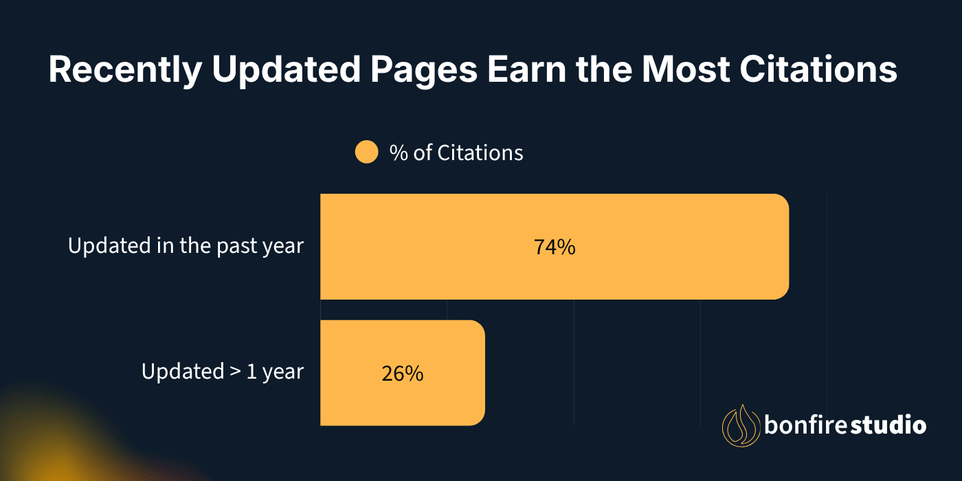
A 2025 study from AirOps, The Silent Pipeline Killer, looked at more than 4,000 pages that ChatGPT cited across 900 high-intent questions in 15 industries.
Across those cited pages, 74% had been updated within the past year, and about a quarter were more than a year old.
Why the Blog is a Freshness Engine
Your website probably (hopefully!) already has pages about your company, the services you provide, how to get in touch, case studies, that sort of thing.
Those are the pages you least want to be rewriting every few months.
They carry your core message and may go a couple years without needing a complete refresh.
A blog is different.
It's the part of your website you can add to regularly without touching anything that's already working.
Depending on your industry, a blog might include:
- Press releases and company news
- Answers to FAQs about your services or industry
- Notes from a recent project
- What a potential client needs to know before hiring
Each new post gives search engines a reason to come back and re-crawl your site (to revisit it and see what's changed). The same goes for humans.
That steady activity keeps the whole domain current, not just the blog.
My guess is that AI tools prefer recent content because recency implies relevancy. For example, a how-to article about SEO that was published last year probably contains information that is no longer accurate.
Frequently Asked Questions
How often should we update the blog?
At minimum I recommend posting to the blog once a month so it doesn’t appear stale. If your team has the capacity (and enough to say) to post more often, once a week is great.
Here at Bonfire Studio we post twice per month.
What should we write about?
For a firm in a regulated industry, the most useful blog posts answer the questions clients and prospects already ask:
- A medical group can cover what to expect as a new patient, or introduce a new provider or service line.
- An environmental consultancy can explain when a Phase I Environmental Site Assessment is required, or what a new regulation means for the businesses it serves.
- A financial advisory firm can walk through what happens to a client's accounts at retirement, or how a recent tax-law change affects planning.
Content like this keeps your website alive and current, and is pretty easy for your team to stay on top of, even if you’re just posting once a month.
Do we have to call it a “blog”?
No, not at all.
In fact, at Bonfire Studio we recently switched from calling our blog a “Blog” to calling it “Insights”. That term more accurately reflects the type of content we share in our blog.
If you plan to use it mainly to share firm news and press releases, you could call it “News”.
If your strategy involves using the blog as a place to share educational content, you might call it “Resources”.
Or, you could use categories to separate the content into two sections… one for “News” and another for “Resources”.
What This Means For Your Company
If you run a specialty medical group, an environmental consultancy, or a financial advisory firm, keeping your website current doesn’t require a marketing department. It requires a knowledgeable hand and a plan for what to publish, and when.
If you need help, reach out to my team today. We can set up a blog on your website that your team can manage, or we can manage it for you (including writing the content).

About the Author: Sara MacQueen
Sara MacQueen is the founder of Bonfire Studio, a boutique web design studio that builds custom websites for established businesses in complex, regulated industries. She has over 20 years of experience spanning design, marketing, and software development.