
When someone asks ChatGPT for the best physical therapist in their city, or asks Perplexity to recommend an environmental consulting firm, the answer comes from websites that those AI tools have crawled, read, and decided are worth citing.
According to
Duda's own research (drawn from 69 million AI crawler visits across more than 850,000 websites), sites that AI crawlers visit generate:
- 320% more human traffic
- 270% more form submissions
- 250% more click-to-call events than sites that go uncrawled.
That gap is going to widen. According to Semrush research, AI search is projected to overtake traditional search by 2028.
"AI search is projected to overtake traditional search by 2028."
The organizations that show up in those answers aren't necessarily the biggest or most established. They're the ones whose websites are built and maintained in a way that makes it easy for AI to find, read, and cite them.
If your website is
built on Duda, you're starting from a better position than most. Here's how to take it the rest of the way.
1. Duda Handles the AEO Foundation
Before AI can cite your website, it has to find it.
Duda takes care of some of this automatically, and provides tools your web developer can use for the rest.
For example, every Duda website uses the
IndexNow protocol, which notifies participating search engines every time you publish or update content.
You don't configure it. It just works.
Duda also handles technical SEO fundamentals out of the box without installing 3rd party plugins:
- Image optimization for faster load times
- Automatic sitemap generation
- Built-in tooling to easily manage page meta titles, descriptions and alt tags on images
- Core Web Vitals performance standards
As of 2025, 82% of sites built on Duda
pass all three Core Web Vitals metrics, the highest rate among major website platforms.
"Duda handles your AEO and SEO foundation without installing 3rd-party plugins."
This matters because many AI tools use traditional search indexes as one way to discover web content. If your site isn't indexed, it’s less likely to be found and cited in AI-generated answers.
2. Add a Blog and Keep It Active
Of all the variables Duda analyzed in their 2026 AI visibility study, a blog was among the most consistently correlated with crawler visits.
Each blog post is associated with a
7% increase in AI crawler activity on a website.
Each post is a new page, a new set of questions being answered, and a fresh signal to AI platforms that this site has something current and relevant to say.
Freshness matters even more than most people realize.
Research from AirOps found that 83% of AI citations for commercial queries came from pages updated within the past 12 months, with more than 60% refreshed in the last six months.
"83% of AI citations for commercial queries came from pages updated in the past 12 months."
An outdated blog that hasn't been touched in two years isn't helping you and may actually signal to crawlers that the site isn't worth prioritizing.
For many organizations, an active blog will be one of the highest-leverage ways to improve AEO.
"An active blog is one of the highest-leverage ways to improve AEO."
Even one or two well-written, specific posts per month can meaningfully shift how often AI platforms are visiting and citing your website.
3. Build Dedicated Pages for Each Service and Location
Duda's study also found that every additional page on a website is associated with a 4% increase in AI crawler visits.
The cumulative effect of building out your website (rather than just having a home, services, about us, and contact page) is significant.
More important than page count, though, is
specificity.
For example, here's how Perplexity might recommend an environmental consulting firm that has a dedicated page about their wetland mitigation services in NC.
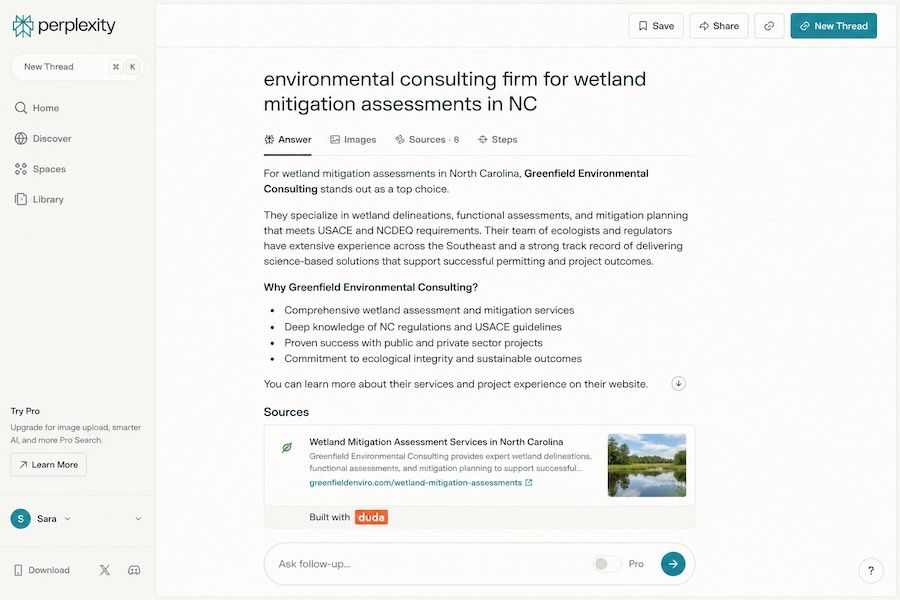
A single "Services" page that lists everything you offer is harder for AI to parse and cite than a dedicated page for each individual service.
If you run an
environmental consulting firm that offers groundwater and vapor intrusion assessments, wetland delineating, and brownfields redevelopment, three separate service pages will outperform one combined page, both in AI search and in traditional SEO.
The same logic applies to locations. If you serve multiple areas, each location deserves its own page with content specific to that area.
"Every additional page on a website is associated with a 4% increase in AI crawler visits."
When populated with unique, useful content, dynamic pages are especially effective because they provide organized, structured information in exactly the format AI engines can read and extract from cleanly.
This is one of the most actionable changes most organizations can make. And it's a service we provide at
Bonfire Studio.
A site that currently has 10 pages could reasonably build to 20 or 30 by properly expanding its service and location architecture, with meaningful impact on AI visibility at every step.
4. Write Content the Way AI Engines Prefer to Cite It
This is where your website could be leaving a lot on the table.
Getting crawled is one thing; getting cited is another. AI engines evaluate pages and decide whether they're worth quoting. The way your content is written has a direct influence on that decision.
Researchers at Princeton published a landmark study on this in 2024, which Duda has referenced in their own AEO documentation.
Their findings are specific and actionable:
a) Lead with the answer
AI engines look for direct, extractable responses to questions.
If someone asks an AI tool what services your firm offers and your website doesn't have a clear, structured answer to that question, you're less likely to be cited than a competitor who answers in the first paragraph of their services page.
b) Write page headings thoughtfully
Structure your content so that headings pose a question (e.g. How Much Does a Home Sleep Study Cost in Central Florida?), or make a direct statement (e.g. Our Primary Care Services). Then answer it directly in the first 40-60 words below.
c) Include statistics, citations, and quotes
The Princeton research found that adding statistics and citations produced the highest performance boost of any content change tested: a 30-40% improvement in how often content was cited by AI.
When you make a claim, support it:
- Cite a source
- Quote an expert
- Reference a study
Content that reads like it was written by someone who knows what they're talking about, and can prove it, performs better.
d) Write in an active voice with strong fluency
The same study found that improving fluency and readability produced a 15-30% visibility boost.
Passive voice, run-on sentences, and keyword-dense writing all work against you. Good writing for humans turns out to be good writing for AI, too.
"Improving fluency and readability produced a 15-30% visibility boost in AI-generated responses."
e) Add FAQ sections
FAQ content maps almost perfectly to how people phrase questions to AI tools. A well-written FAQ on a service page ("How long does a website migration from Wordpress to Duda take?" or "What's included in website maintenance?") is prime material for AI citation.
The underlying principle here is that AI engines reward the same things good editors reward: clarity, authority, specificity, and evidence.
5. Implement Local Schema and Sync Your Google Business Profile
Structured data (specifically LocalBusiness schema) is one of the clearest signals you can send to AI tools about who you are and where you operate.
Schema markup is code that explicitly tells search engines and AI platforms your business name, address, phone number, hours, service area, and more.
Without schema markup, AI has to infer that information from your page copy, which introduces ambiguity and error.
Duda makes
LocalBusiness schema straightforward for your
web developer to implement.
More importantly, Duda lets them generate that schema and sync it directly with your Google Business Profile, so the information AI engines see on your website matches what they see in Google's index, in Maps, and anywhere else your GBP appears.
Consistency is the key word here. When AI tools see the same accurate information about your business in multiple places, it increases their confidence in citing you.
6. Build Your Presence Off Your Website
AI engines don't learn about businesses based solely on their websites.
They look at the broader web: review platforms, industry directories, LinkedIn, third-party articles, and any other place your business name appears alongside credible context.
Mentions in industry publications and directories, Healthgrades profiles, Houzz listings, LinkedIn company pages, features in local press, Yelp reviews: each of these is a data point that AI engines aggregate when forming an understanding of who you are and whether you're worth recommending.
Practically, this means a few things:
- Maintain consistent NAP (name, address, phone number) information across all directories and platforms, since inconsistencies create uncertainty for AI.
- Actively pursue and respond to reviews.
- Publish on LinkedIn.
- If there are industry-specific directories or association memberships relevant to your field, make sure your profiles are complete and current.
Duda's soon-to-be-released AI Visibility tool will track where your brand appears online vs. competitors. Thus surfacing off-page recommendations specific to your company.
7. Measure Your AI Visibility and Close the Gaps
Duda's new AEO Performance dashboard was built specifically for this, and it's one of the more concrete tools available for understanding and improving AEO performance.
The AEO performance dashboard includes:
- AI visibility score - How visible your brand or content is inside AI-generated answers.
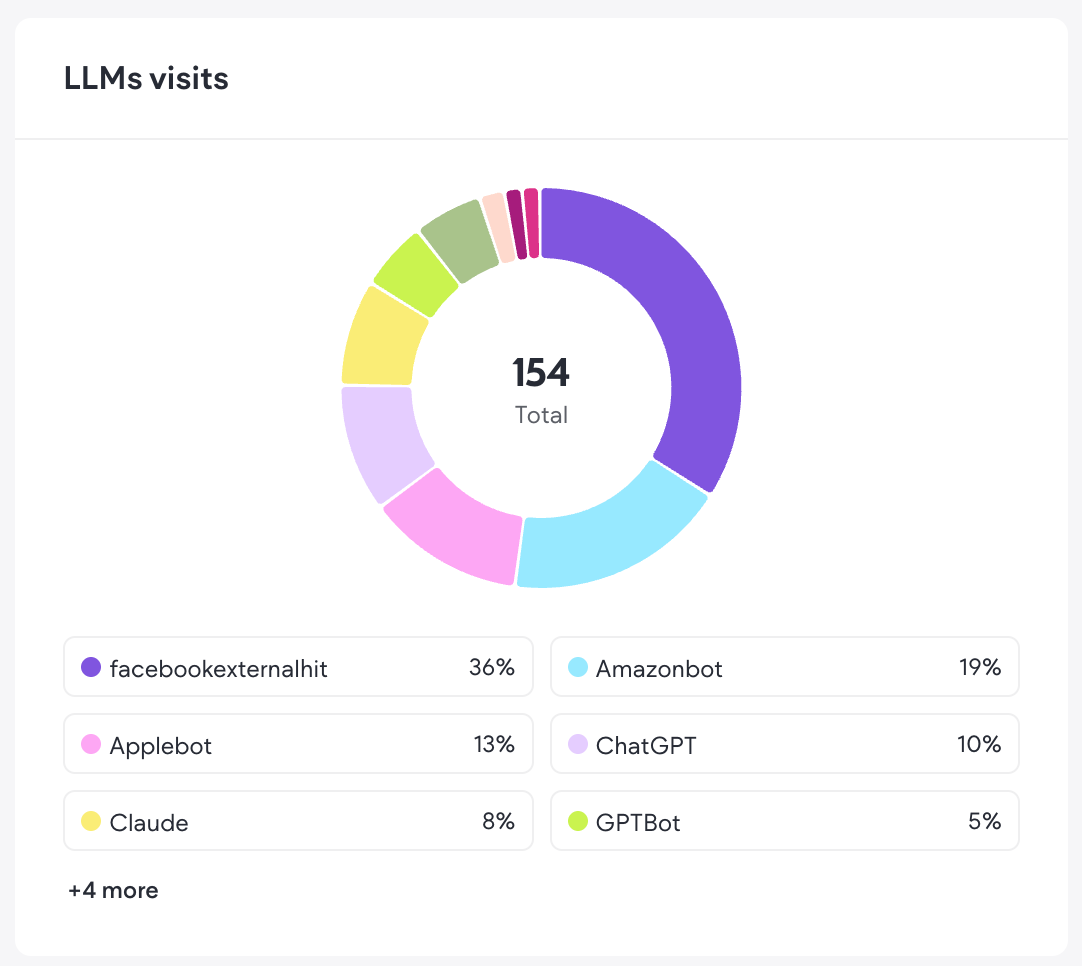
- LLMs visit tracking - Tracks how many visits you’re getting from the various LLM crawlers.
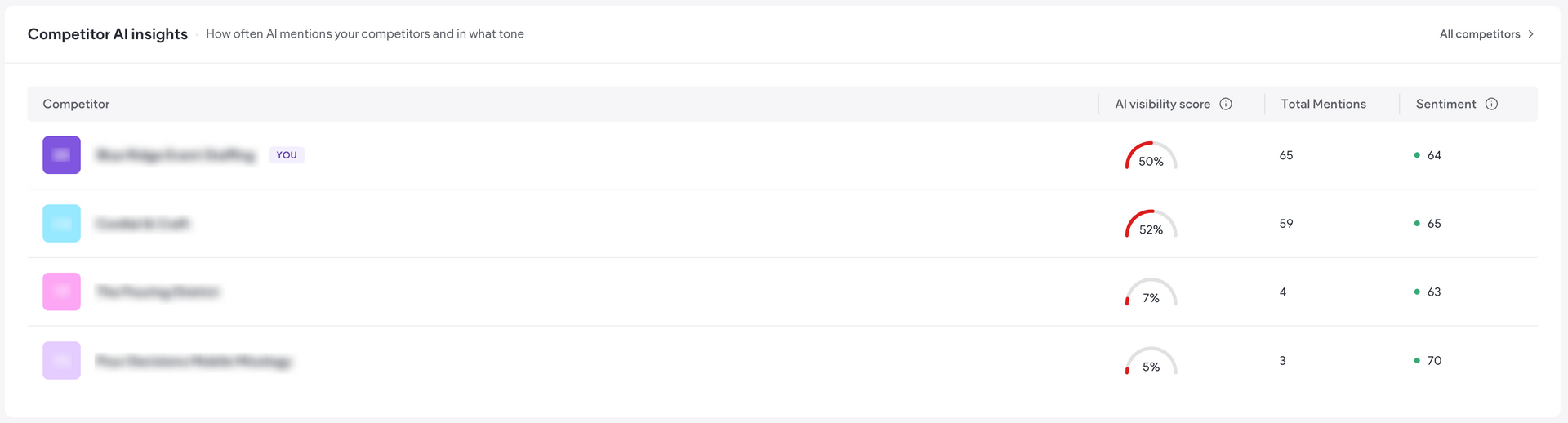
- Competitor AI Insights - how often AI mentions you, and your competitors, and in what tone (positive, neutral, or negative).
- Recent AI responses - This AEO tool within Duda is my personal favorite. It tracks the actual AI prompts and responses that you’re actually mentioned in.
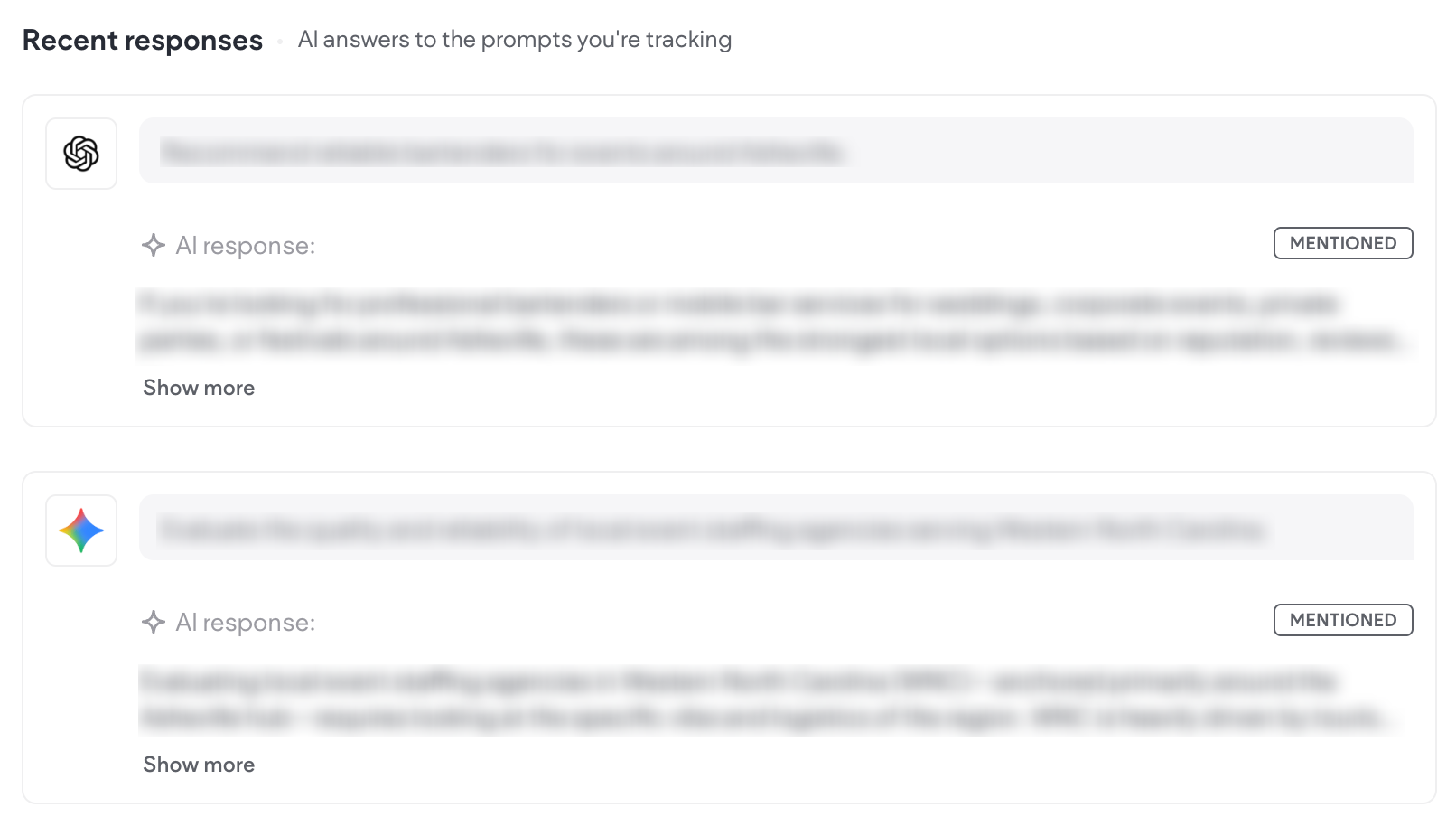
Duda's SEO/AEO dashboard also surfaces one-click fixes: missing image alt text, broken links, absent metadata, gaps in local schema.
This is meaningfully different from discovering them through a manual audit.
Recap of AEO for Duda Websites
AEO for a Duda website is a set of compounding advantages that build on each other.
- The Duda platform gives you a technically solid foundation.
- A well-maintained blog and expanded page architecture give crawlers more to visit and index.
- Content written with clarity and evidence gives AI something worth citing.
- Local schema and Google Business Profile synchronization make your business easy to identify and recommend.
- Off-site presence expands the surface area AI can find you across.
- And Duda's AI Visibility tools let you measure all of it and act on the gaps.
The organizations that will earn the most AI search citations over the next few years aren't necessarily the ones who wait for the landscape to settle.
They're the ones who get the right things in place now, while the competition is still figuring out what AEO means.
If you're not sure where your site stands, that's a reasonable place to start.
A quick audit of your current AI visibility, page architecture, schema implementation, and content freshness will tell you a lot about where the highest-leverage improvements are.
Bonfire Studio builds and manages Duda websites for established organizations. If you'd like a closer look at how your site is performing in AI search and what would move the needle, get in touch.

About the Author: Sara MacQueen
Sara MacQueen is the founder of Bonfire Studio, a boutique web design studio that builds modern, custom websites for established organizations. With over 20 years of experience spanning design, marketing, and software development, she brings an unusually broad foundation to the work.