
Website Design for Environmental Consulting Firms
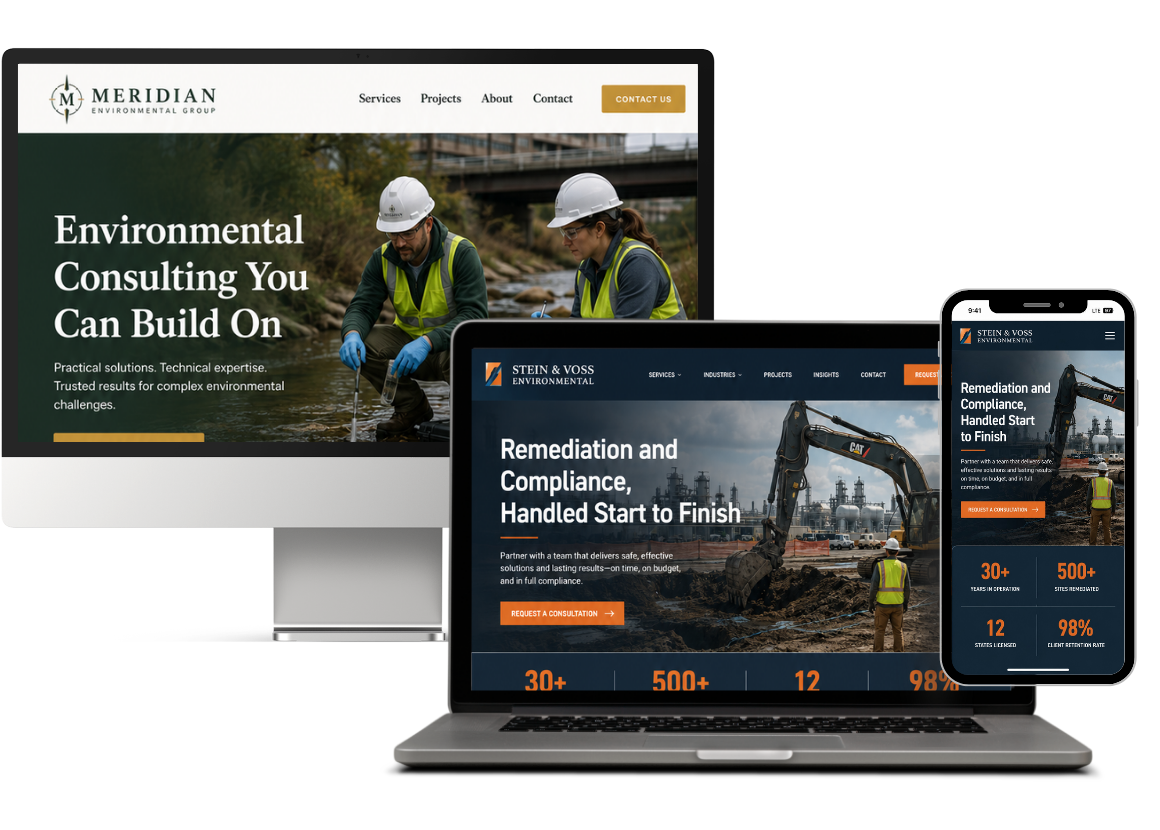
Your website is often the first real impression a prospective client, a regulator, or a referral partner gets of your firm — before they ever talk to your team or see a single field report. If that impression doesn't match the quality of work you actually do, it's working against you.
That's the problem we solve. Bonfire Studio designs and builds websites for established environmental consulting firms — and then keeps them running properly afterward. Website design for environmental consulting firms isn't a side category for us. It's a specific problem with specific stakes, and we treat it that way.
A Website That Doesn't Reflect Your Firm's Expertise is Working Against You
Environmental consulting firms earn trust through fieldwork, technical reports, regulatory relationships, and staff credentials built up over years. None of that shows up automatically on a website.
A lot of firm websites were built years ago. They get small updates here and there — a new staff photo, an updated service — but the structure, the message, and the overall impression haven't changed since. Meanwhile, the people deciding whether to call your firm are forming an opinion based on exactly that website.
A corporate client doing due diligence before hiring an environmental consultant is going to look at your site. So is a municipal procurement officer. So is the attorney or developer who might refer you to their client.
If the site looks like it was built for a different era of your firm — or hasn't been kept updated — it's quietly working against the reputation you've built everywhere else.
This is the gap most environmental consulting websites fall into, and it's the one worth closing.
What a Website for an Environmental Consulting Firm Needs to Do
A good environmental consulting website design isn't just a digital brochure. It has three jobs that generic small-business sites don't usually have to think about.
Build trust with more than one audience
Most businesses design their site for one type of visitor. Environmental consulting firms have at least three, and each is reading the site for different signals.
Corporate and commercial clients — property owners, developers, manufacturers — want to know you understand their industry, can move at the pace of a transaction, and have done this kind of work before.
Regulatory agencies and municipalities want to see that your firm operates with the rigor and documentation they expect, and that you can be a reliable point of contact on public projects.
Referral sources — attorneys, lenders, developers who bring you in on behalf of their own clients — want reassurance that recommending your firm won't reflect poorly on them.
A site built around "what we do" in generic terms tends to speak to none of these audiences specifically. One built with these three groups in mind — even subtly, in how services and project work are framed — does a lot more work before anyone picks up the phone.
Present technical project work clearly
Phase I and Phase II environmental site assessments, remediation, ongoing monitoring, ecological and wetland services — this is the heart of what your firm does, and it's exactly the kind of work that's hardest to show on a website.
Part of that is confidentiality. You can't always name the client or the site. Part of it is jargon — the people reading your site aren't all environmental scientists, and a page full of regulatory citations and technical acronyms can do more to obscure your expertise than demonstrate it.
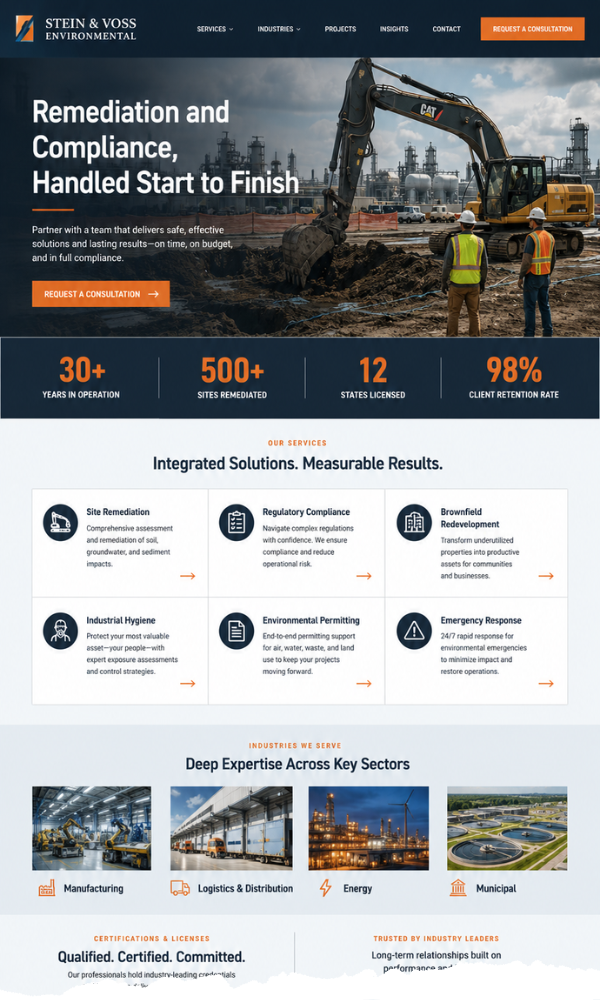
The fix isn't to leave project work off the site, and it isn't to publish full case studies with client names attached. It's to build a structure — categorized by service type or project type — that shows the range and scale of what your firm has handled, in language a corporate client, a regulator, and a referral partner can all follow, without compromising anyone's confidentiality.
Show the credentials that matter
Professional Geologists, Professional Engineers, Certified Hazardous Materials Managers, safety certifications, agency accreditations — these credentials are a big part of why clients and regulators trust your firm.
For an environmental consulting firm, credentials aren't a footnote. They're evidence. A website that surfaces staff licenses, certifications, and safety records as part of the normal browsing experience — not as an afterthought — is doing real work toward building trust with every audience that matters.
How Our Process Works
A website redesign for an established firm shouldn't take over anyone's calendar. It shouldn't require a steering committee or a long list of decisions handed back to your team with no guidance. Here's how we keep it moving instead.
1
Project Kick Off
We start by understanding your firm — services, audiences, project history, and what's not working about the current site. We ask the right questions upfront, and recommend a direction for structure and design. From there, the project moves.
2
Design & Development
We design and build the site — the project showcase, staff and credentials pages, accessibility, and everything else in the agreed structure. You'll see progress along the way, but you won't be asked to manage it.
3
Launch & Ongoing Care
We handle the technical side of going live — migration, testing, redirects — so the transition doesn't create gaps in your search visibility. After launch, we maintain the site on an ongoing basis, so it stays current and secure without becoming another responsibility for your team.
Every Environmental Consulting Firm Website We Build Includes
Custom On-Brand Design
Not a reskinned template. The site reflects your firm's actual identity, services, and tone — built to look like the established firm you are.
Staff & Credentials Pages
Licenses, certifications, and team expertise presented as part of the site's structure, not buried in a downloadable file.
Project & Case Studies
The range and depth of your experience — by service type, sector, or project scale — without compromising client confidentiality.
SEO
A site structure built so search engines — and the people searching — can find the services you offer and the areas you serve.
Accessibility Built-In
ADA and Section 508 considerations addressed from the start, not added after a complaint or a contract requirement.
An Ongoing
Care Plan
Once the site launches, someone keeps it updated, secure, and current. That someone is us.
Why Environmental Consulting Firms Choose Bonfire Studio
Environmental consulting firms come to us after recognizing that their current site doesn't reflect the firm they've become — and that fixing it requires outside help and expertise.
We're not the cheapest option, and we're not trying to be. We're also not a DIY platform or an agency built around presentations and process for its own sake. We're a boutique studio that combines the agility of a small team with the technical execution of a much larger one — and we take responsibility for the result.
That's the real difference. The value isn't just a new website for environmental consulting firms. It's handing off the responsibility of managing one — the redesign, the launch, and everything after — to someone who treats it as their job, not yours.
Frequently Asked Questions
How long does a website redesign take for an environmental consulting firm?
Timelines vary based on the scope of the project — particularly how much project and credential content needs to be organized — but most redesigns move from kickoff to launch over a period of 6 to 8 weeks. We set a realistic timeline at the start and keep the project on track without requiring constant check-ins from your team.
Can we showcase past projects without sharing confidential client information?
Yes. We have experience building project and case study sections structured around service type, sector, and scope rather than client identity, so your firm's experience and capabilities come through clearly without naming clients or sites that need to stay confidential.
Does Bonfire handle ADA and Section 508 accessibility for government clients?
Yes. Accessibility is built into the site from the start, with ADA and Section 508 considerations in mind — which matters if your firm works with municipalities, school districts, or other public agencies where accessibility may come up during procurement.
What website platform do you build on, and why?
We build on Duda. It gives us a strong technical foundation — fast load times, built-in security, and accessible-by-design tools — without the plugin sprawl that slows down and introduces security risks into other platforms. It also makes ongoing updates simple, which matters once the site is live.
Who maintains the website after it launches?
We do. Every project includes an ongoing care plan, so your site stays current, secure, and accurate as your firm changes — without it becoming another responsibility for your team to manage.
What does a website redesign cost for an established firm?
It depends on the scope — particularly the size of your project showcase and how much existing content needs to be reorganized versus rebuilt. We'll give you a clear, specific number during the proposal stage, based on your firm's actual needs. To give you an idea now, an 8-page website including content writing would cost about $8000.