
What ChatGPT Reads Before It Recommends an Environmental Consulting Firm
A study of 1,029 citations across 72 questions in 12 U.S. metros — and the firm pages behind them.
Bonfire Studio · Published September 8, 2026 · Queries run August 21-24, 2026
When a developer, a municipality, or a law firm asks ChatGPT to recommend an environmental consulting firm, the model draws on its existing knowledge and, when appropriate, searches the web, evaluates what it finds, and cites relevant sources.
Those citations come back as structured links, a matter of record. So it's possible to ask a question, get an answer, and see where the model got its information.
Over a four day period in August 2026 we asked ChatGPT to recommend environmental consulting firms. We asked 72 distinct questions, each repeated three times on separate days, across twelve U.S. metropolitan markets and six service specialties.
Every question requested a recommendation: “We have a project near ‹metro› that needs ‹specialty›. What are the top 3 firms you recommend we hire?”
We captured every source it cited - 1,029 citations.
This study is about the moment a buyer is choosing an environmental consulting firm, and where ChatGPT goes to decide who to recommend.
Key findings
- Firms' own websites dominate the citations. 72% of all 1,029 citations pointed to a consulting firm's own website. Government and regulatory sites accounted for another 25%. Everything else combined (directories, “top firms” lists, trade associations, news, social media) came to under 3%.
- ChatGPT cited specific pages, not homepages. Of the firm pages it cited, only 6.5% were homepages. The rest were interior pages about the firms' services, locations, company, past work, and so on.
- The cited pages answer what you do and where. Of the firm pages ChatGPT cited, the largest groups were pages about a firm's services and pages about the places it works — together about two-thirds.
- Which firm gets named is unstable. Ask the same question on different days and only ~40% of the specific firms recur, but the kind of source cited holds almost perfectly steady.
- National firms are named more often than regional ones. Of the firm citations, about 56% went to national firms and 35% to regional or local ones (the rest to adjacent firms).
- No single firm owns the citations. The firm citations were spread across 158 different firms; the five most-cited together accounted for less than a quarter of them.
A remarkably narrow set of sources
Of the 1,029 sources ChatGPT cited across the study, nearly three-quarters were consulting firms' own websites. Government and regulatory pages made up most of the rest.
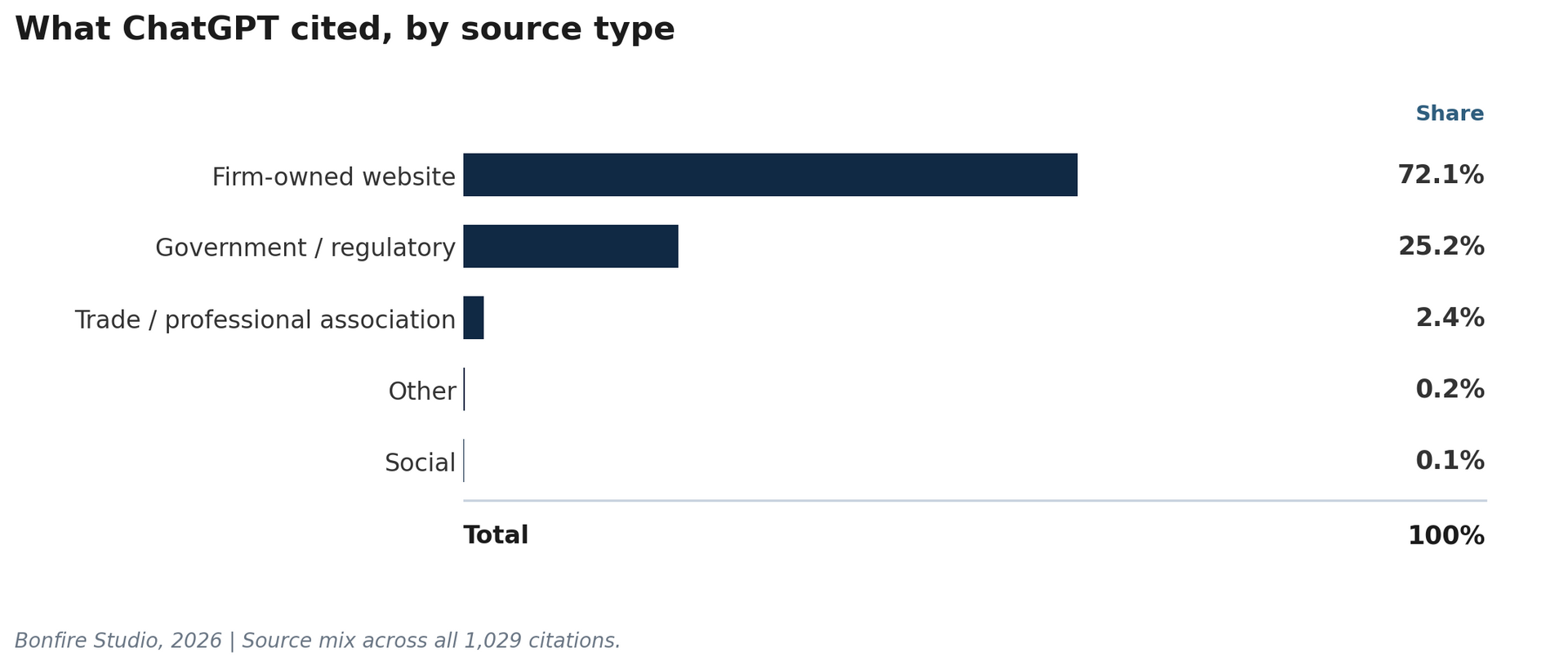
What's striking is the absence. There were no directories, no Yelp-style listings, essentially no social media, and very few professional associations.
The citations were dominated by firm-owned (72.1%) and government/regulatory (25.2%) websites.
The practical read is simple. Of the sources ChatGPT relies on, the one a firm can actually control is its own website.
Also important to note is that nearly every answer cited at least one government or regulatory source: the EPA, a state environmental agency, the Army Corps.
It cites your website — but not your homepage
We wanted to know which pages on a firm's website were getting cited. So we took every firm-website citation, reduced it to unique pages, and manually sorted each page by what it's about.
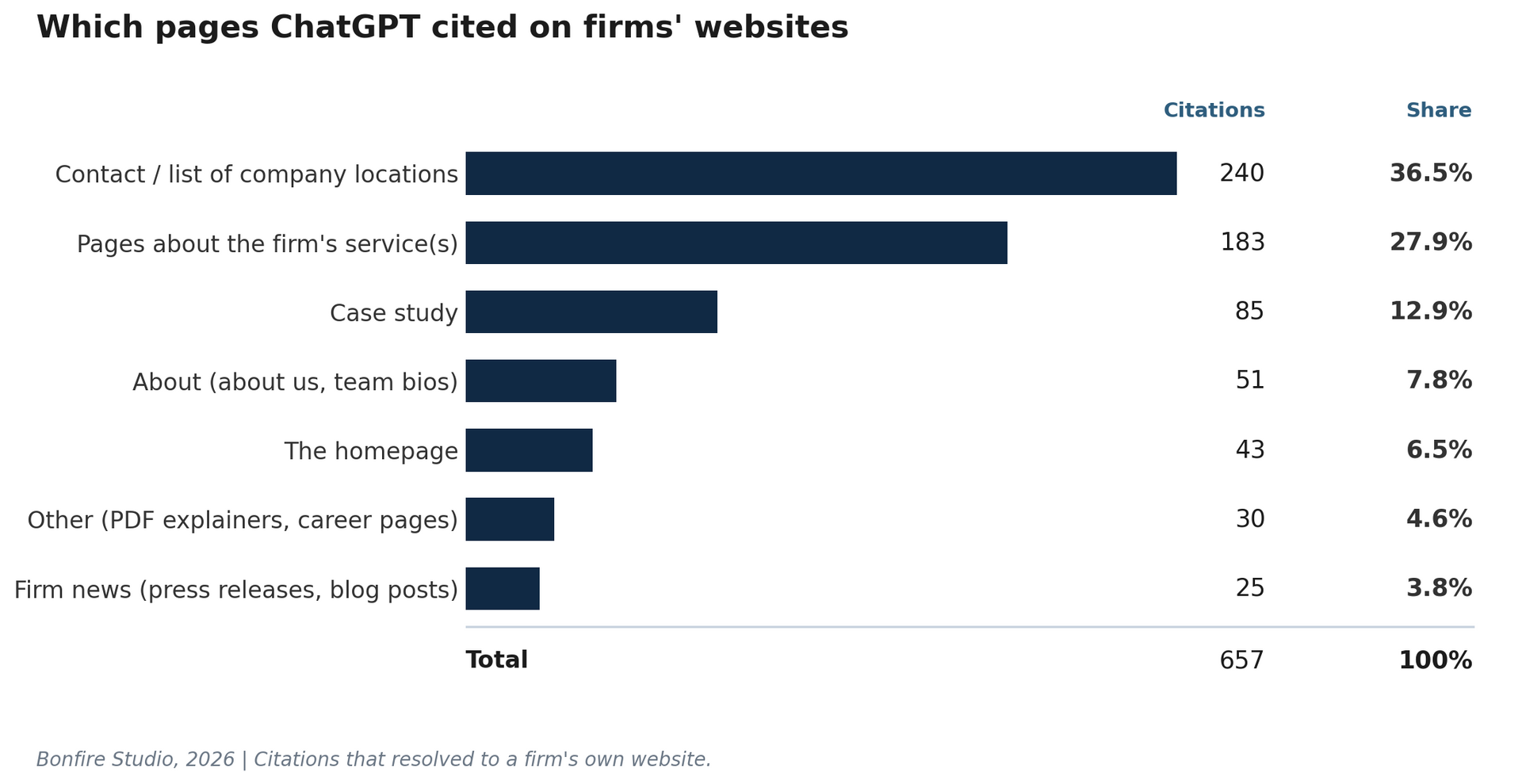
Homepages were only 6.5% of the citations. The rest went to interior pages — service pages, location pages, case studies, and the like.
The two largest groups were pages tied to a specific service and pages tied to a specific place. Together they made up about two-thirds of the citations.
This result is not surprising as the questions we posed asked for a recommendation based on service and location. It also fits the nature of environmental consulting work, which is usually a defined service delivered in a specific place.
The cited pages answer what you do and where
The findings suggest a well-built service page (27.9% of the citations) is one of the best ways to tell both a visitor and ChatGPT what you do.
Location and contact pages (36.5% of citations) answer the other half of the question — where you work. For a firm with a single office, that might be the contact page. For a firm operating in dozens of markets, that could be a separate page for each, or a page that lists all their locations.
Case studies were the third most-cited page type, at 12.9%. They answer both halves of the question at once: a project page describing a Phase II assessment at a named site says what you did and where you did it, in specific terms.
Interestingly, 3.8% of the citations went to news and blog pages on firms' websites. Many of these were press releases about completed projects.
This suggests the specific page type may matter less than where the answer sits. A recommendation question is answered by whatever page states plainly what a firm does and where.
Which firms ChatGPT recommends is unstable
We ran every question three times, on three separate days, and compared the results. Two things stood out.
First, the field is wide. The 742 firm citations were spread across 158 distinct firms, and the five most-cited firms together accounted for less than a quarter of all firm citations. This is not a market where a handful of names own the recommendations.
Second, which firm gets named is unstable, but what kind of source gets cited is not. Ask the same question on different days and only about 40% of the specific firms recur. But the source mix barely moved: firm-website share was 70.6%, 73.5%, and 72.2% across the three runs.
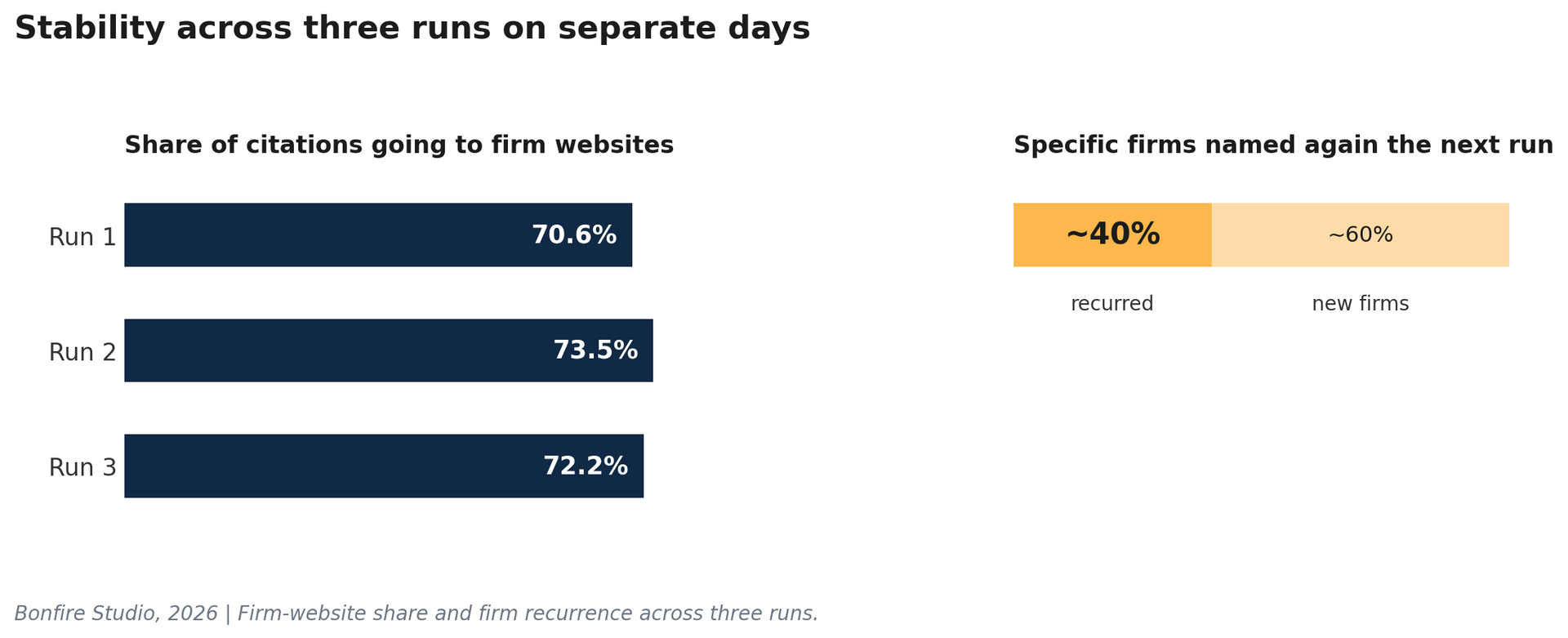
The takeaway is oddly encouraging. Getting recommended isn't a fixed ranking you win once. The results change from one run to the next, and no competitor has a permanent hold on the top spot.
What kind of work you do changes the odds
The specialty being asked about shifted the balance between national and local firms more than anything else we measured.
On wetland delineation (e.g. field-driven, regionally specialized work), 74% of firm citations went to local and regional firms.
On NEPA compliance (e.g. work tied to federal actions and requirements), 88% went to national firms.
Phase I and Phase II assessments split roughly evenly.
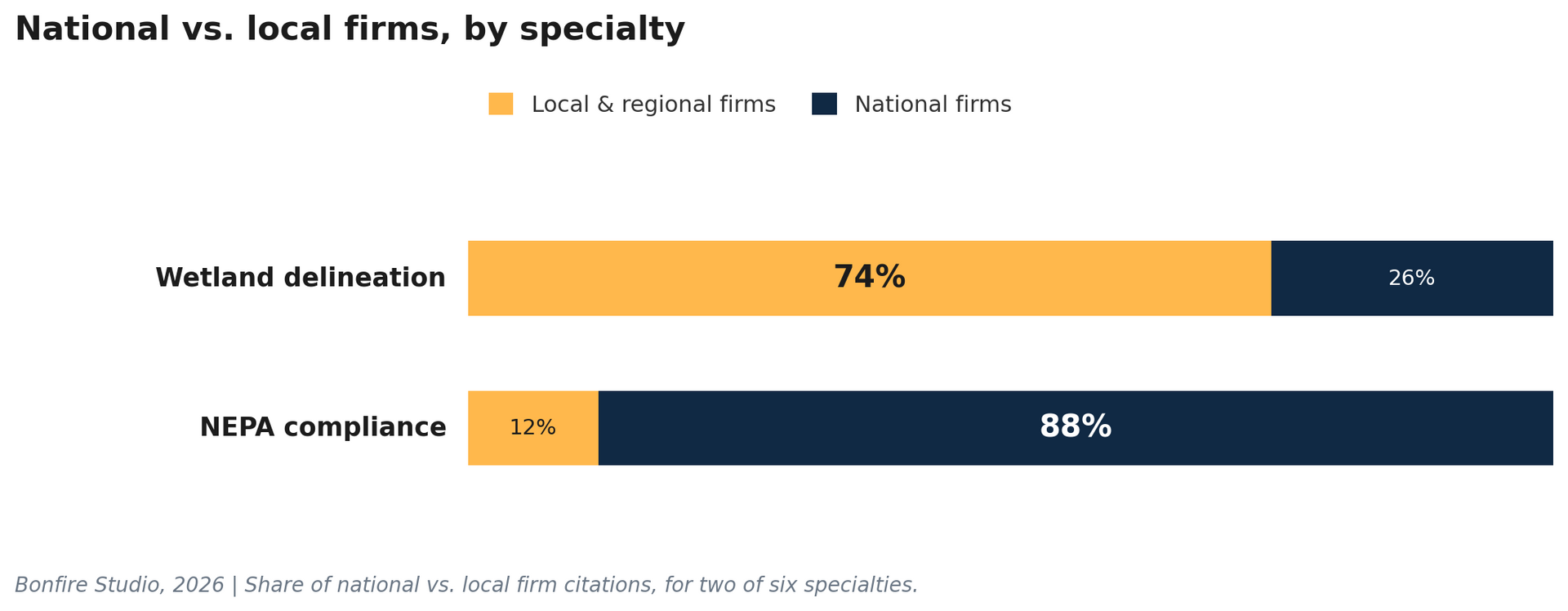
We can't say why the balance shifts this way. National firms may do more federal work and publish more about it, or the model may lean toward them for this kind of question. But the pattern holds either way.
For a regional firm the takeaway is practical: some service lines are far more winnable than others. Your odds of being recommended for wetland delineation near your market are structurally better than your odds for federal NEPA work, where the national firms dominate.
What this means for your website
The findings point to a few concrete things for an environmental consulting firm.
- Your website is what's being evaluated. When ChatGPT recommends a firm, it's drawing almost entirely from that firm's own website — 72% of every source we captured. It's also the one source here that a firm fully controls.
- A thin site could be costing you business. A four- or five-page brochure website doesn't give the model much to cite. The firms that got recommended had built out real pages for the services they offer, the places they work, and the projects they've done.
- Build the pages that answer what you do — and where. Service pages, pages for the markets you serve, and case studies were the most-cited page types. Those are the pages worth writing well and keeping current.
- Give your key markets their own pages. A single-office environmental consulting firm may need just one clear contact page that states their address. A firm with offices across many markets needs a page for each, or a page that lists them all.
- You don't need a national footprint. Of the firms that were cited by ChatGPT, 35% were regional or local. For a smaller firm, a clear and specific website is a lever you have.
Visual credibility
Content gaps
Mobile responsiveness
Overall functionality
Who it's for: established organizations that suspect their website may be falling behind. Always performed by a real human. :)
Free Website Audit
Research method
Model and interface
We used gpt-5.6-sol (the model behind ChatGPT for Plus subscribers as of August 2026), called through the OpenAI API with its hosted web-search tool enabled, at the default (“low”) search-context setting. We captured citations from the structured annotations the API returns, rather than parsing them out of the prose, so the source list is exact.
Questions
Every question used the same template: “We have a project near ‹metro› that needs ‹specialty›. What are the top 3 firms you recommend we hire?”
Specialties
We used six specialties:
- Phase I Environmental Site Assessment
- Phase II Environmental Site Assessment
- Wetland delineation
- NEPA compliance
- Brownfield remediation
- Air-quality permitting
Markets
We chose twelve metropolitan markets, two per state across six states, deliberately pairing a larger metro with a smaller one in the same state.
- Texas: Houston and Corpus Christi
- Florida: Miami and Tallahassee
- California: Los Angeles and Fresno
- New Jersey: Newark and Trenton
- Illinois: Chicago and Peoria
- Maryland: Baltimore and Annapolis
Holding the state constant while varying market size let us test whether smaller markets shift recommendations toward local firms, without confounding it with differences in state regulation. The states themselves were chosen as dense, active environmental-consulting markets spread across regions of the country.
Run dates
We asked all 72 questions (twelve metros × six specialties) three times, on three separate days between August 21 and August 24, 2026, to measure day-to-day stability. The 1,029 figure is the total citations captured across all three runs.
Categorization
Each cited domain was sorted into a source type using deterministic rules first, a language model for the remainder, and a manual audit of the highest-volume and most ambiguous domains.
Page analysis
For the page-level findings we kept only firm-website citations and deduplicated them to unique URLs (400 pages accounting for 657 citations). Each page was classified by hand from its URL and title, with ambiguous ones manually reviewed.
Limitations
- Retrieval layer. The model matches the consumer ChatGPT product, but the API's web-search tool is not identical to the app's browsing, so the exact pages surfaced may differ from what a person sees in the app.
- Correlational. We observe what gets cited, not why. “These pages get cited” is not proof that building such a page causes a citation, though the model's own stated reasons consistently point the same way.
- Time and sample. This is a snapshot of four days in August 2026; models and their retrieval change.
Data availability
The full question set, and the complete list of cited URLs are available to the media on request.
Disclosure
Bonfire Studio is a woman-owned web design studio that builds websites for established firms in complex, regulated industries, including environmental consulting. We've reported the data as we found it, including the findings that complicate the story. The full results are available on request.

