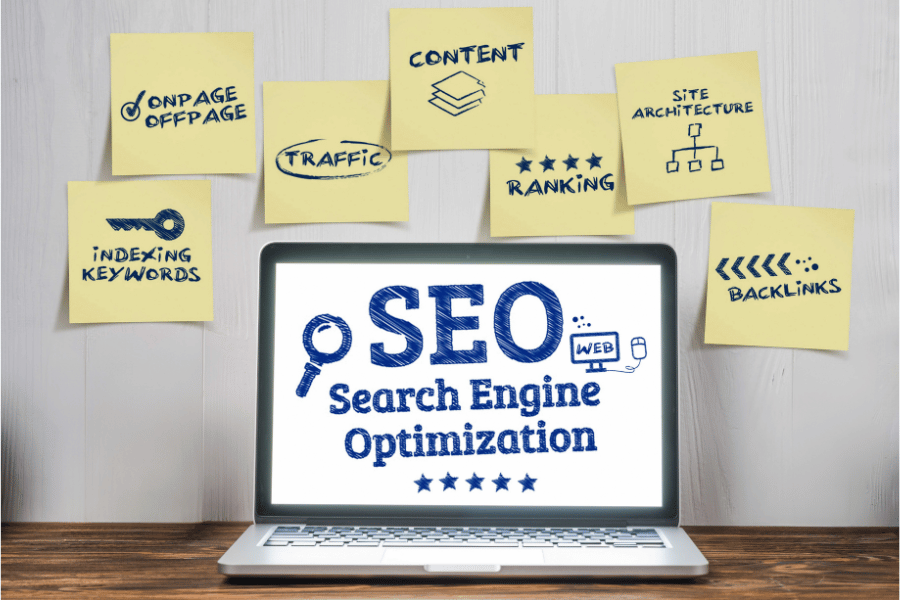
If you are having your company website built, or rebuilt, there are some important things about SEO that are worth knowing before the project begins.
Even your company’s business website is already humming away online, this is good to know information about how SEO works.
While it’s not on you to be the SEO expert, having some background knowledge is useful when evaluating web design companies and hiring service providers.
I’m the owner of Bonfire Studio, a web design studio that builds custom websites for companies that don’t have time to micro-manage the process.
I built my first website over 20 years ago, a lot has changed with SEO during that time. Let’s dive into what matters in 2026!
In this article:
I’ll cover what search engine optimization is, how Google evaluates websites, and what that means for the way your site should be built.
Part 1: What SEO Is and Why It Matters
Part 2: How Google Evaluates Your Website
Part 3: What Every Website Should Include
Part 1: What SEO is and Why it Matters
What Is SEO?
Search engine optimization (SEO) is the practice of building and maintaining a website so that it surfaces in search results when people are looking for what you offer.
It is not a single tactic. It is a collection of decisions made when structuring, creating content for, and maintaining a website.
Some of what’s involved in SEO doesn’t directly involve your website - which I’ll explain in part 3 about local SEO.
Done well, SEO means your website is:
- Easy for search engines to find
- Clearly understood as relevant to the right topics
- Trusted enough to rank well among search engine results
Why SEO Matters
Organic search - the results that appear when someone types a query into Google - accounts for a significant share (53%) of all website traffic.
It captures people at different stages of the buying process:
- Some are researching a category
- Some are looking for service providers
- Some are ready to make a decision
A well-positioned website can reach all of them.
For established businesses, a strong presence in search is not just a marketing tactic. It is a business development channel that works consistently.
Because Google holds approximately
90% of the global search market, this guide focuses primarily on how Google works.
Part 2: How Google Evaluates Your Website
Discovery, Relevance, and Authority
Understanding how Google evaluates websites makes it easier to see why the decisions made during a website build matter so much.
Discovery
Before Google can rank your site, it has to find it.
Google uses automated bots called crawlers to discover pages across the web. It then adds them to its “index” - a massive catalog of content it draws on when someone searches.
A well-structured website is easy for Google to discover, crawl and index completely.
Relevance
Once Google has found your website, it works to understand what it is about.
It looks at the content, the page structure, the title, and the keywords used throughout.
Pages that clearly address a specific topic - using the language your potential clients are actually searching - are more likely to surface for those searches.
Authority
While relevance tells Google what a page is about, authority tells Google whether to trust it.
Authority is built over time, largely through links from other reputable websites pointing to yours (aka "backlinks").
The more quality links a site earns, the more authority it carries, and the more favorably Google tends to treat it in rankings.
"All the content in the world doesn’t matter if you don’t have authority." (Hubspot)
E-E-A-T: What Google Values
Underlying all of this is a framework Google uses to evaluate the quality and credibility of web content:
E-E-A-T, which stands for Experience, Expertise, Authoritativeness, and Trustworthiness.
In practice, E-E-A-T shows up on a business website in some of these ways:
Experience
Evidence that the people behind the content have done this work firsthand
- Case studies and project portfolios
- Named authors with relevant professional backgrounds
- Content that reflects genuine on-the-ground knowledge, not generic information
Expertise
Signals that the business and its people know their field
- Team pages with credentials, roles, and bios
- Blog content that demonstrates depth, not just breadth
- Specific, accurate information that a non-expert would not know to include
Authoritativeness
Recognition from outside sources that the business is credible
- Links from reputable industry websites, publications, or partners
- Media mentions, awards, or professional affiliations
- A track record that is visible and verifiable online
Trustworthiness
Signals that the business is legitimate and reliable
- Reviews and testimonials from real clients
- A well-maintained About page that accurately reflects the company today
- Consistent, accurate business information across the web
Part 3: What Every Website Should Include
1. Site Structure and Page Depth
This is one of the most consequential decisions made during a website build - how to structure your website, what pages to include and what content to include on those pages.
Small (in terms of the number of pages) and narrow websites will not perform as well in search as larger websites that provide a lot of information about your products/services and company.
For example, it might seem like overkill to build out individual pages about each service your company offers - but it is not.
Small websites will not perform as well in search as large websites with a lot of information.
Individual service pages (depth) is one of the best ways to signal to search engines what your website is about and therefore, get found in search by potential customers searching for those services.
What this means in practice
This is not an argument for an unnecessarily large website. It is an argument for a site sized to match the full range of services and searches relevant to the business — not just the four things that fit on a homepage.
2. Page Titles and Meta Descriptions
Page titles (the <title> tag behind each page) and meta descriptions are two foundational elements of a well-optimized website.
Page titles are a direct ranking signal. Meaning, they tell Google what a page is about, and they often appear as the clickable headline in search results.
A clear, well-written title that reflects the page content and includes relevant search language will consistently outperform one that does not.
Meta descriptions are the supporting text beneath that headline in search results. They are not a direct ranking factor, but they directly influence whether someone clicks.
A well-written meta description gives the right person a clear reason to visit.
Before hiring a web designer, be sure they will include unique page titles and meta descriptions on each page of your website
3. A Blog or Resources Section
For businesses that want to perform well in search over time, a blog is one of the most effective tools available - and it is often underestimated.
Every new article is a page Google can index and rank — expanding the range of searches your site can surface for beyond what core service pages can cover.
A consistent body of well-written content also signals genuine expertise to Google, directly supporting E-E-A-T.
And useful, well-crafted articles are far more likely to earn links from other reputable sites than a static services page - and high-quality links are one of the strongest authority signals available.
One important caveat: a blog that goes quiet can work against you.
A news section with nothing recent, or an insights page untouched for months, raises questions - is this business still active? Is this information current?
If maintaining a blog consistently is not realistic, it is worth thinking carefully about how it appears on the site, rather than letting it go stale.
That said, maintaining a blog doesn’t require adding new content every week. Your blog might get updated just once a month, and that’s fine as well.
The bar is not volume. It is consistency and usefulness.
4. Local SEO
For businesses that serve a specific city or region, local search is an additional layer that impacts SEO, and it deserves its own attention.
Google Business Profile
This is the foundation of local search visibility. Your Google Business Profile powers the map results and the business panel that appears alongside search results.
Keeping your Google Business Profile accurate, complete, and actively maintained is one of the highest-leverage things a local business can do.
NAP Consistency
NAP stands for Name, Address, Phone number.
Google cross-references this information across your website, your Google Business Profile, and the various directories where your business appears online.
Inconsistencies — different phone numbers, outdated addresses, old locations still listed — create confusion and can suppress local rankings.
Consistency across every listing matters more than most businesses realize.
Location-Specific Pages
For businesses that serve multiple locations or want to rank in specific markets, dedicated pages for each location or service area give Google a clear signal about where you operate and who you serve.
A single page that mentions several cities in passing is far less effective than a well-structured page built specifically for each.
Location-specific pages is a strategy we used with our client Clark Health.
They operate a network of primary care clinics across their state, so we built out a unique page for each location explaining what services are offered and what providers work from that location.
SEO Isn’t a Feature, it’s a Mindset
SEO is not a feature to add during or after a website project.
It is built into the decisions made at the beginning and throughout - how the site is structured, how many pages it includes, what each page covers, and how the content is written.
When those decisions are made well, results can come faster than most people expect.
For example, within ten days of launching a newly rebuilt website for Headshot Love, an Asheville-based headshot photography studio, their top priority search terms moved from page five of Google results to position six on page one — without any paid advertising.
The site was simply built the right way.
Be sure to ask your web design partner how they approach SEO before you hire them.
Final Thoughts
Thinking about a new website and want to understand how yours currently performs in search?
We offer a free website audit — no pressure, no obligation. We will give you an honest read on what is working, what is not, and what is worth addressing.
Contact us and request a free website audit →

About the Author: Sara MacQueen
Sara MacQueen is the founder of Bonfire Studio , a boutique web design studio that builds modern, custom websites for established organizations. With over 20 years of experience spanning design, marketing, and software development, she brings an unusually broad foundation to the work.